
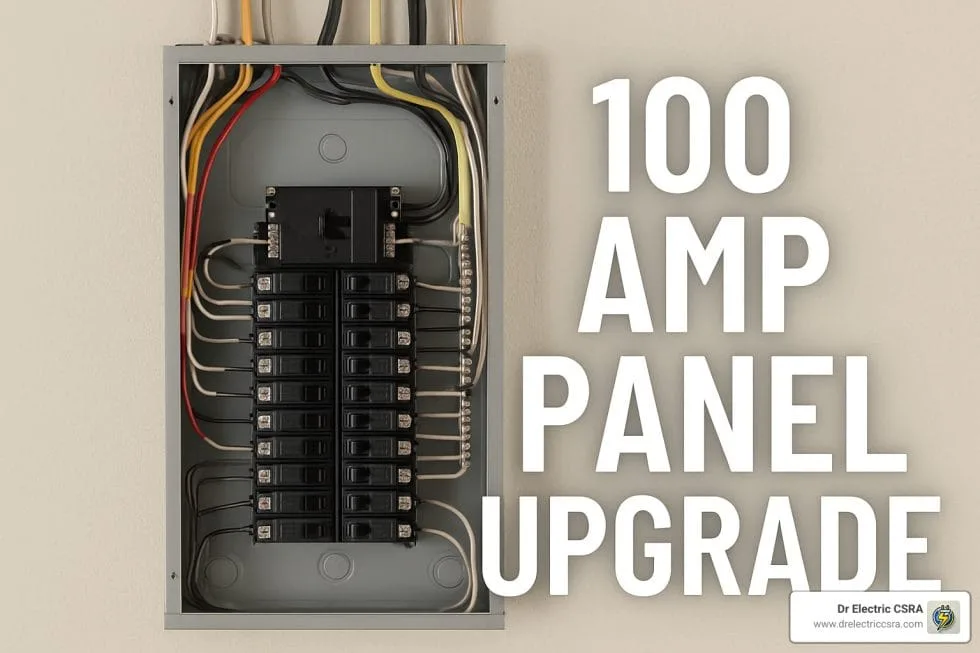
Why 100 Amp Panel Upgrades Matter for Augusta Homeowners
A 100 amp panel upgrade is one of the most important electrical improvements you can make to your home. Whether you’re adding an EV charger, installing a hot tub, or just tired of tripped breakers, upgrading your electrical panel ensures safety and meets modern power demands.
Quick Answer: When You Need a 100 Amp Panel Upgrade
– Frequent breaker trips when running multiple appliances
– Flickering lights during high-demand usage
– Adding major appliances like EV chargers or heat pumps
– Home is 25+ years old with original electrical system
– Planning renovations or room additions
– Switching from gas to electric appliances
The research shows that most electrical panel upgrades involve replacing a 100-amp panel with a 200-amp panel, with costs typically ranging from $1,300 to $3,000. Many Augusta-area homes built before 2000 still rely on 100-amp service that simply can’t handle today’s electrical loads safely.
Modern homes require significantly more power than older electrical systems were designed to provide. A 100-amp panel maxes out at 24,000 watts of total capacity, but you should never load it beyond 80% (19,200 watts) for safety. When you factor in HVAC systems, kitchen appliances, and potential EV charging, that capacity gets eaten up quickly.
I’m Jesse Burnett, Master Electrician and founder of Dr. Electric CSRA, and I’ve completed over 1,200 electrical projects including dozens of 100 amp panel upgrade installations across the Central Savannah River Area. My team and I help Augusta homeowners steer the upgrade process safely, ensuring every installation meets code and comes with our 5-year workmanship warranty.
100 amp panel upgrade definitions:
– cost of new electrical panel
– new electrical panel
Why This Guide Matters
If you’re considering a 100 amp panel upgrade in Augusta, Evans, Grovetown, or Martinez, this guide will walk you through everything you need to know. We’ll cover the basics of electrical capacity, help you determine if an upgrade is necessary, explain the costs and process, and share alternatives that might save you money.
Understanding your home’s electrical needs isn’t just about convenience—it’s about safety. Older panels can be a leading cause of structure fires, and undersized panels force homeowners to rely on dangerous workarounds like overloaded circuits and excessive extension cords.
100 Amp Panels 101: Capacity, Parts & Lifespan
Understanding your home’s electrical panel is like understanding the heart of your electrical system. A 100 amp panel upgrade starts with knowing what you’re working with, so let’s break down the basics in simple terms.
Your 100-amp electrical panel serves as mission control for all the electricity flowing through your home. When power comes from the utility company, it arrives at your panel first, then gets distributed to individual circuits that power everything from your kitchen outlets to your air conditioning system.
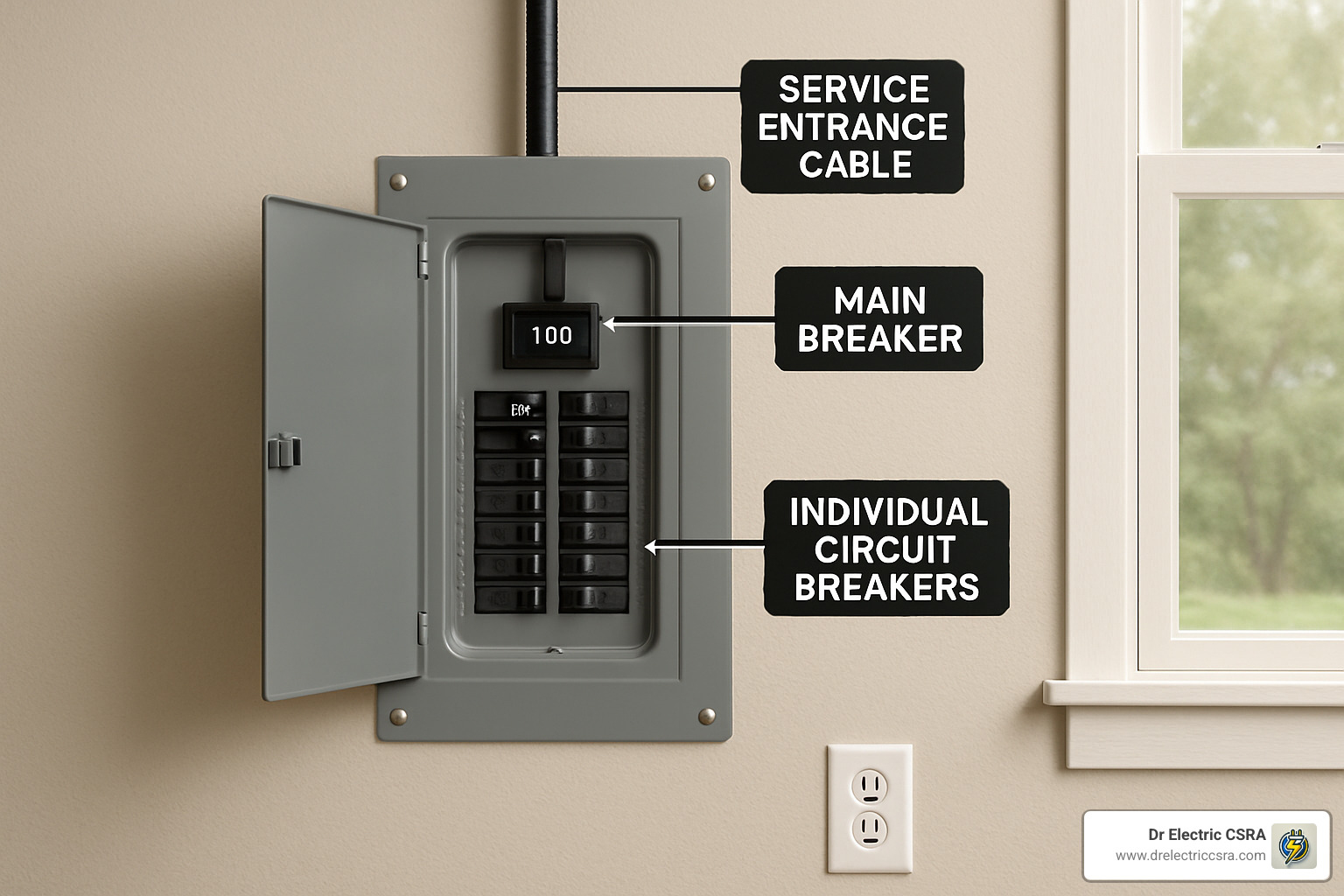
The “100 amp” rating tells you the maximum electrical current your panel can handle safely—exactly 100 amperes. Here’s where the math gets interesting: 100 amps multiplied by 240 volts gives you 24,000 watts of total capacity. But here’s the catch—electrical code requires you to never load a panel beyond 80% of its capacity for safety reasons. That means your actual usable capacity is only 19,200 watts.
Think of it like a highway with a speed limit. Your car might go faster, but staying within the limit keeps everyone safe.
Your 100-amp panel contains several key components that work together. The main breaker acts like the master switch, shutting off power to your entire home when needed. Individual circuit breakers protect specific areas—typically 15-20 amp breakers for regular outlets and lights, and 30-50 amp breakers for major appliances like your dryer or electric range.
The service entrance cable brings power from your utility meter to the panel, while the grounding system provides crucial safety protection against electrical shock. Most 100-amp panels offer between 20-40 breaker spaces, which determines how many individual circuits you can have.
Like most home systems, electrical panels don’t last forever. A well-maintained panel typically serves reliably for 25-40 years. After that, you might notice corroded connections, outdated safety features, or simply insufficient capacity for modern electrical demands.
100 Amp vs 200 Amp At-a-Glance
When considering a 100 amp panel upgrade, many homeowners wonder about jumping straight to 200-amp service. The differences are significant and worth understanding.
| Feature | 100 Amp Panel | 200 Amp Panel |
|---|---|---|
| Total Capacity | 24,000 watts | 48,000 watts |
| Usable Capacity (80% rule) | 19,200 watts | 38,400 watts |
| Typical Breaker Spaces | 20-30 spaces | 40-42 spaces |
| Service Wire Size | 2/0 copper or 4/0 aluminum | 3/0 copper or 4/0 aluminum |
| Best For | Smaller homes, gas appliances | Modern homes, electric appliances |
| Panel Cost | $100-200 | $250-350 |
| Installation Cost | $850-1,600 | $1,300-3,000 |
The wiring requirements change dramatically between these two options. A 100-amp service typically uses 2/0 copper conductors or 4/0 aluminum conductors. The 200-amp service demands larger 3/0 copper or 4/0 aluminum wiring. Your meter base and utility connection must also match the amperage rating—you can’t just swap panels without considering the entire system.
Typical Load Profiles in 2024 Homes
Here’s where things get real for Augusta homeowners. Modern homes are electrical powerhouses compared to what we had even 20 years ago, and the numbers tell the story.
Your HVAC system alone can draw substantial power. Central air conditioning typically pulls 15-20 amps (3,600-4,800 watts), while an electric heat pump can demand 15-25 amps (3,600-6,000 watts). Add an electric water heater at 20-25 amps (4,800-6,000 watts), and you’re already using a significant chunk of your 100-amp capacity.
Kitchen appliances pack another punch. An electric range or oven requires 30-50 amps (7,200-12,000 watts), while your electric dryer needs 30 amps (7,200 watts). Even smaller appliances add up—your dishwasher uses 10-15 amps, the microwave pulls 8-12 amps, and the garbage disposal needs 8-10 amps.
Then there’s the big game-changer: EV chargers. A Level 2 home charging station typically requires 32-48 amps (7,700-11,500 watts). That’s nearly half your panel’s safe capacity right there.
When I calculate load profiles for Augusta-area homes, a typical all-electric house might draw 30 amps per leg during normal operation. But here’s what keeps electricians up at night—motor starts can spike those numbers to 45-60 amps temporarily. When your air conditioning kicks on while you’re cooking dinner and charging your Tesla, that 100-amp panel starts feeling pretty cramped.
The reality is that modern homes, especially those switching from gas to electric appliances, often outgrow 100-amp service quickly. That’s why many of our customers find themselves considering not just a 100 amp panel upgrade, but a jump straight to 200-amp service for future-proofing.
Do I Need a 100 Amp Panel Upgrade? Signs, Load Math & Future Plans
Let’s be honest—most homeowners don’t think about their electrical panel until something goes wrong. But there are clear signs that tell you when your current setup isn’t cutting it anymore.
The most obvious red flag is frequent breaker trips. If you can’t run your air conditioner and electric dryer at the same time without losing power to half your kitchen, that’s your electrical system crying for help. Flickering lights when major appliances kick on is another telltale sign, especially during those hot Augusta summers when your AC is working overtime.
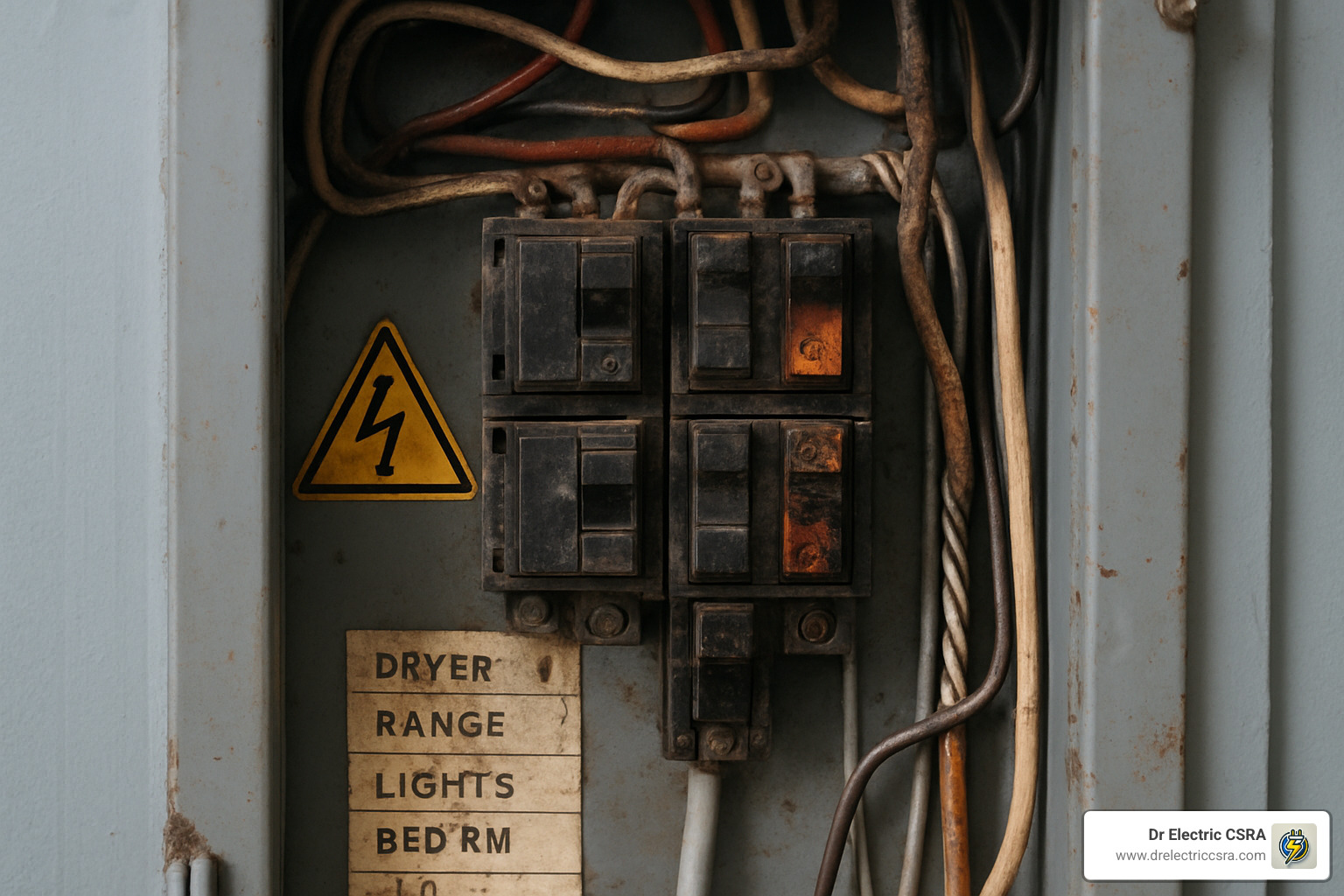
More serious warnings include warm panels or burning smells—these require immediate attention from a licensed electrician. Buzzing or crackling sounds from your panel indicate loose connections that could spark a fire. If you notice rust or corrosion on breakers, moisture has gotten where it shouldn’t be, and that’s never good news.
Here’s something that might surprise you: if you’re still using multiple extension cords around your house, the problem isn’t that you need more power strips—you need more circuits. And if your home still has an old fuse box, you’re looking at a maximum of 60 amps, which barely covers modern needs.
8 Clear Warning Signs:
1. Breakers trip when running multiple appliances
2. Lights flicker during appliance startup
3. Panel feels warm or smells like burning
4. Buzzing or crackling sounds from panel
5. Rust or corrosion on breakers
6. Still using a fuse box
7. Relying on multiple extension cords
8. Home is over 25 years old with original electrical
100 Amp Panel Upgrade Decision Factors
The decision to upgrade isn’t just about current problems—it’s about planning for your family’s future needs. Square footage plays a big role here. Homes under 3,000 square feet that still use gas for heating, water heating, and cooking can often manage on 100 amps. But if you’re planning to go all-electric or add major appliances, that changes everything.
Your current fuel mix matters tremendously. Many Augusta families are making the switch from gas to electric appliances for efficiency and cost savings. Each change increases your electrical demand. An electric heat pump system, induction cooktop, and heat pump water heater can easily push your home beyond 100-amp capacity.
Think about your appliance timeline too. Are you planning to buy an electric vehicle in the next few years? A Level 2 EV charger needs its own 40-48 amp circuit. That’s nearly half your panel’s safe capacity right there.
The 80 percent rule from NEC Article 220 is crucial for safety. Your panel should never be loaded beyond 80% of its capacity. For a 100-amp panel, that means you can safely use only 80 amps continuously. When we do a demand calculation for your home, we add up lighting loads (about 3 watts per square foot), appliance loads, and HVAC requirements, then apply demand factors since not everything runs at once.
Here’s a real example from a recent Augusta project: A 2,000 square foot home calculated out to 29,500 watts total demand. Divided by 240 volts, that’s 123 amps required—well beyond what a 100-amp panel can safely handle.
When a 200 Amp Service Becomes Inevitable
Some additions make a 100 amp panel upgrade to 200-amp service practically unavoidable. Hot tubs typically need 40-60 amp dedicated circuits. Whole house generators require substantial capacity for their automatic transfer switches. Solar battery systems need additional circuits and often demand larger service capacity.
Electric vehicle charging is becoming the tipping point for many families. A Tesla Model 3 with a 48-amp charger can fully charge overnight, but that’s nearly half your 100-amp panel’s safe capacity. Add in your existing appliances, and you’re asking for trouble.
The electrification trend is real in Augusta. Families are switching to heat pump HVAC systems, electric water heaters, and induction ranges. Each change pushes electrical demand higher. A typical all-electric home easily draws 120-150 amps during peak usage, making 200-amp service not just convenient, but necessary for safety.
Costs, Incentives & Home-Value Boost
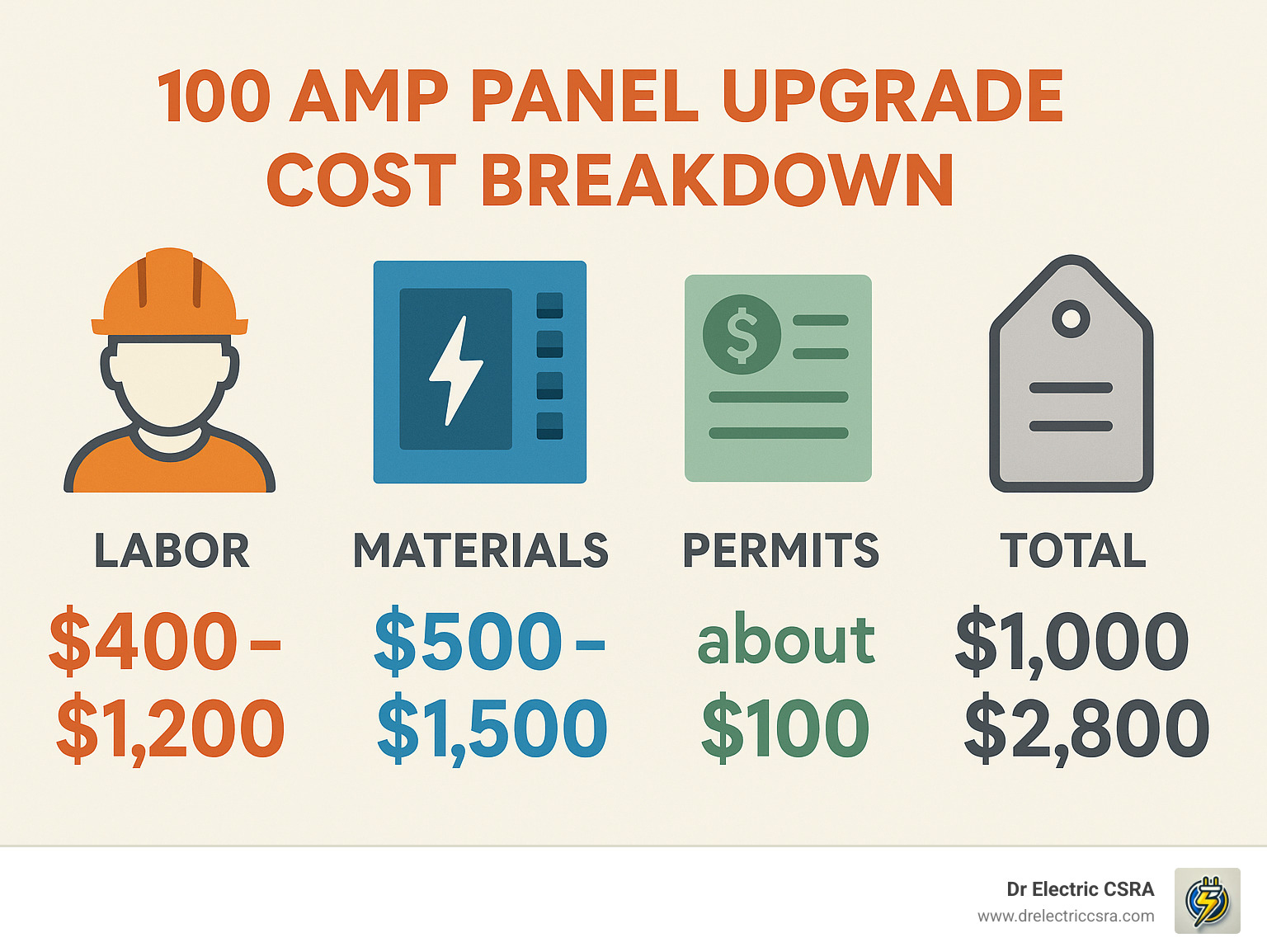
Let’s talk money—because nobody likes surprises when it comes to home improvement costs. A 100 amp panel upgrade is a significant investment, but understanding the numbers upfront helps you plan and budget effectively.
Here in Augusta, most homeowners spend between $1,300 and $3,000 for a complete panel upgrade. The wide range depends on your specific situation, but I’ll break down exactly what goes into these costs so you can set realistic expectations.
Labor typically runs $50 to $120 per hour, and most upgrades take our team 8 to 10 hours to complete properly. That works out to roughly $400 to $1,200 in labor costs. The panel itself and materials add another $500 to $1,500, while permits and inspections usually cost $50 to $300 depending on your local jurisdiction.
The good news? Augusta-area costs tend to fall on the lower end of national averages. We have competitive labor rates and reasonable permit fees compared to larger metropolitan areas.
Several factors can bump up your total cost, though. Moving your panel to a new location adds $800 to $2,000 to the project. If we need to upgrade your service entrance cables, expect another $500 to $1,500. Underground service requiring trenching can add $1,000 to $3,000, and extensive rewiring to bring older circuits up to code might add $500 to $2,000.
Budgeting a 100 Amp Panel Upgrade
When planning your 100 amp panel upgrade budget, it helps to understand what you’re actually paying for. The main panel enclosure costs $200 to $400, while the main breaker adds another $50 to $100.
Individual circuit breakers vary widely in price. Standard breakers cost $15 to $25 each, but GFCI and AFCI breakers required by modern code run $35 to $60 each. Since the 2020 National Electrical Code requires AFCI protection in most living areas, expect several of these pricier breakers in your upgrade.
A surge protection device is now required for all new electrical services and costs $150 to $300. This isn’t optional—it’s code—but it’s also excellent protection for your expensive electronics and appliances.
Don’t forget about the “hidden” costs that can catch homeowners off guard. Your utility company might require a meter upgrade costing $200 to $500. Updating grounding electrodes to current standards adds $100 to $300. We’ll need temporary power during installation, which costs $100 to $200. And if your panel is mounted on an interior wall, expect $200 to $500 for drywall repair afterward.
Financing & Utility Rebates
Here’s where things get interesting—there are actually several ways to reduce your out-of-pocket costs for a 100 amp panel upgrade.
Utility rebate programs can provide substantial savings. Some utilities offer rebates up to $4,200 for low-income households making electrical upgrades. Load management programs sometimes provide discounts for installing smart panels that can automatically reduce power during peak demand periods.
If you’re planning to install an EV charger, check for charging rebates that include panel upgrade incentives. The Charge Ready Home program in some areas provides rebates specifically for electrical panel upgrades needed to support electric vehicle charging.
Federal incentives through the Inflation Reduction Act (HEEHRA) include rebates for electrical panel upgrades when they’re part of home electrification projects. Tax credits may also apply if your upgrade supports broader energy efficiency improvements.
Georgia occasionally offers energy efficiency rebates that include electrical upgrades, though these programs come and go. It’s worth checking with Georgia Power or your local utility before starting your project.
The financial benefits extend beyond rebates, too. A modern electrical panel typically increases your home’s resale value by $2,000 to $5,000. Many homeowners also see insurance savings when they upgrade from old fuse boxes or outdated panels that insurers consider fire risks.
When you factor in the safety improvements, increased capacity for modern appliances, and potential insurance savings, a 100 amp panel upgrade often pays for itself over time while giving you peace of mind today.
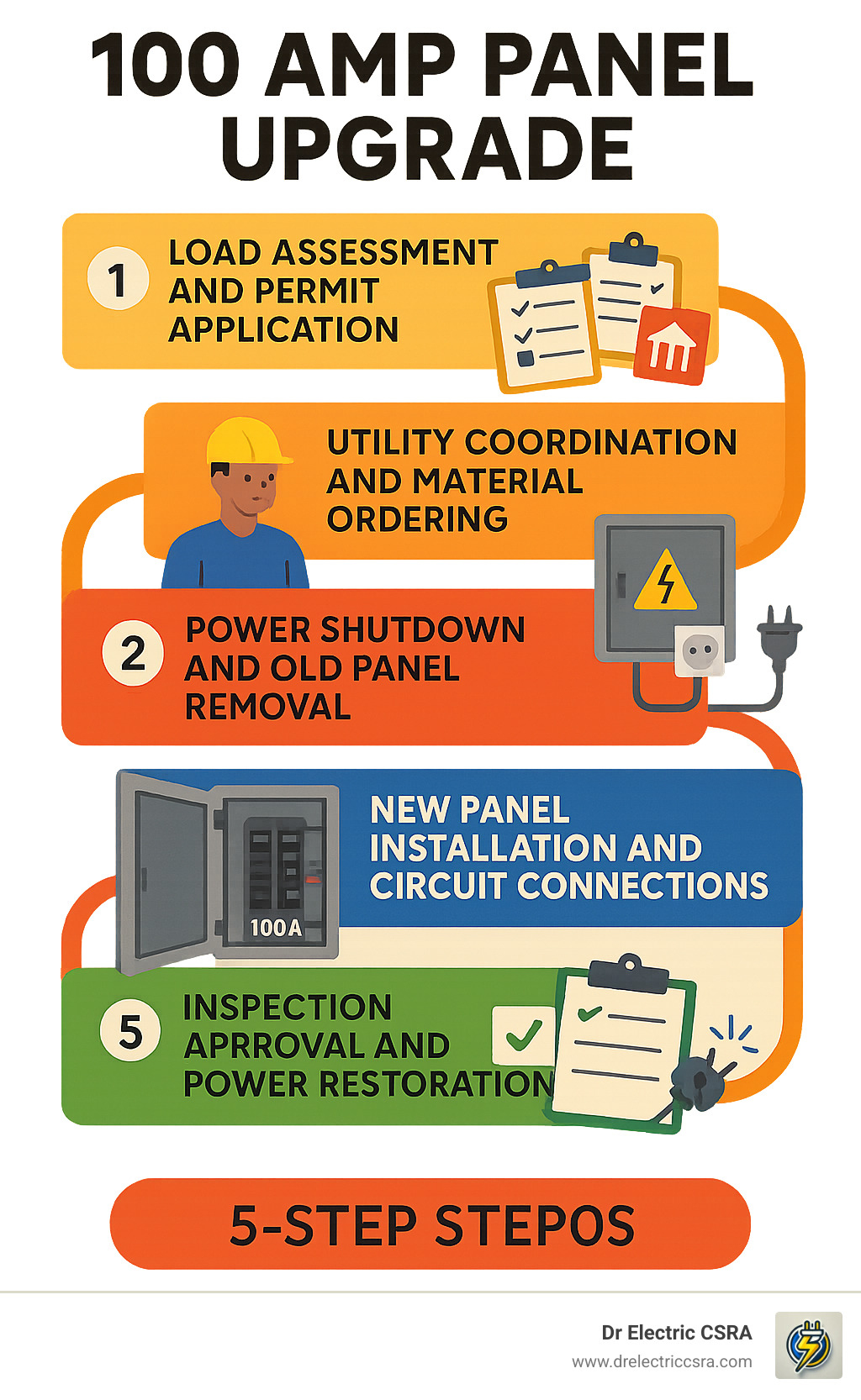
From Permit to Power-On: The 100 Amp Panel Upgrade Process
A 100 amp panel upgrade typically takes 8-10 hours to complete, but the entire process from permit to final inspection spans 1-2 weeks. Understanding each step helps you prepare for the project and minimize disruptions to your daily routine.
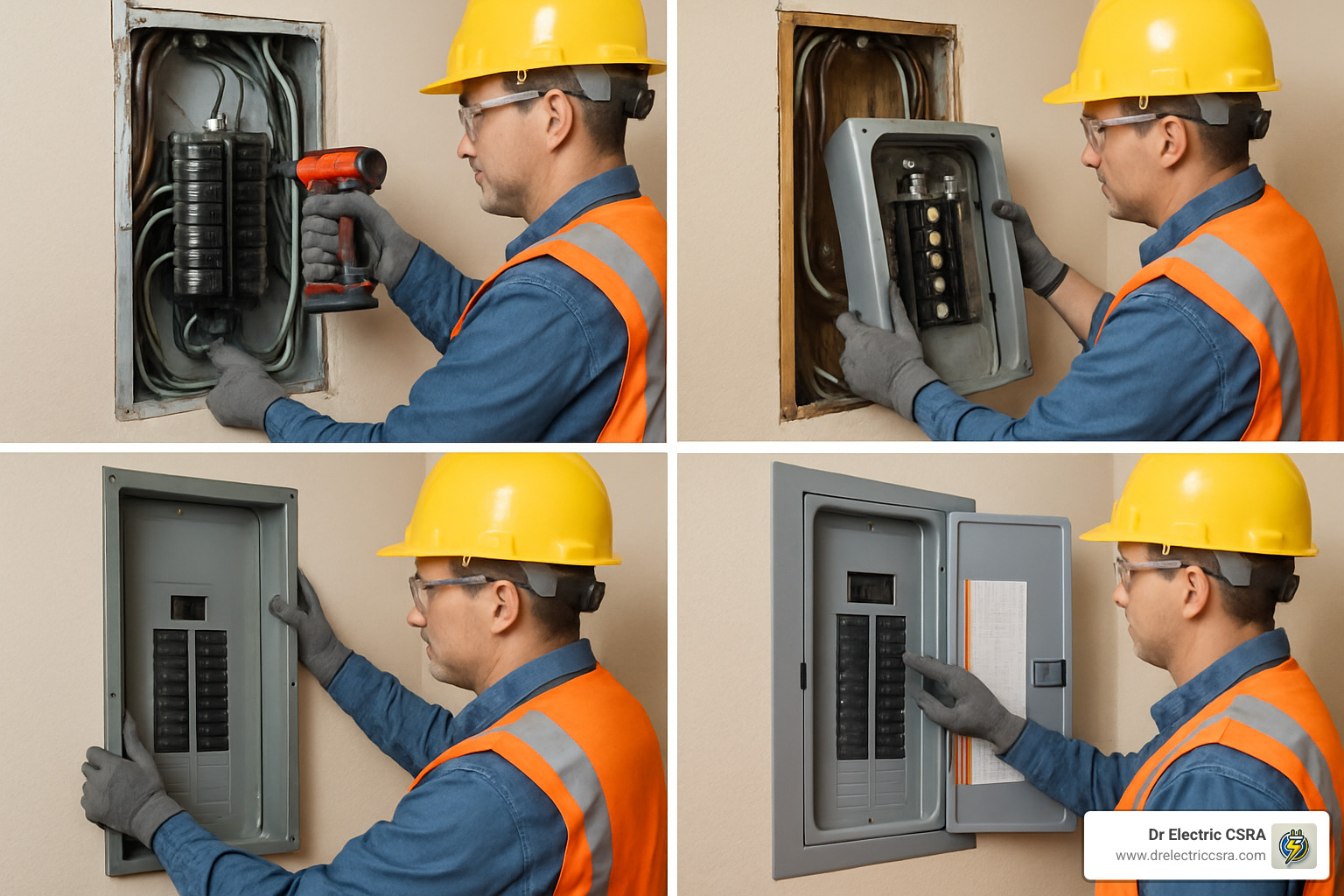
The journey begins with a comprehensive site assessment where we examine your current panel, service entrance cables, meter base, and overall electrical system. This initial evaluation helps us determine whether you need just a panel replacement or a complete service upgrade from the meter to your house.
Utility coordination becomes crucial if your upgrade requires new service entrance cables or meter base changes. We handle all communication with your utility company, scheduling any necessary disconnections and reconnections. This step often determines your project timeline since utility schedules can vary.
The most disruptive part is the power shutdown window lasting 4-8 hours during the actual panel replacement. We work efficiently to minimize this interruption, often scheduling work for times that least impact your household routine. Many families choose to spend this time away from home or plan activities that don’t require electricity.
100 Amp Panel Upgrade – Step-By-Step Timeline
Week 1 focuses on planning and permits. We start with site assessment and load calculations during the first two days, then submit permit applications that typically get approved within 3-5 days. The final days of week one involve material ordering and coordinating with your utility company.
Week 2 brings the actual installation phase. Material delivery and prep work happen on day one, followed by the main installation day when we shut down power, remove your old panel, and install the new system. The remaining days cover inspection scheduling, approval, and final connections with power restoration.
The detailed installation day unfolds in carefully planned stages. We begin with morning setup, staging materials and preparing safety equipment for about an hour. Power shutdown takes around 30 minutes, whether handled by us or requiring utility disconnection.
Old panel removal requires 2-3 hours of careful work, methodically disconnecting each circuit and safely removing the existing equipment. We label everything carefully to ensure proper reconnection.
New panel installation takes 3-4 hours and involves mounting the new enclosure, making main electrical connections, and connecting all your home’s circuits to new breakers. This phase requires precision and attention to code requirements.
We wrap up with testing and cleanup over 1-2 hours, thoroughly testing every circuit and cleaning the work area. Final power restoration takes about 30 minutes for those last connections and the exciting moment when your lights come back on.
Choosing & Hiring the Right Electrician
Selecting the right contractor for your 100 amp panel upgrade directly impacts your safety, code compliance, and long-term satisfaction. The electrical panel is literally the heart of your home’s electrical system, so this isn’t the place to cut corners.
Essential qualifications start with a valid electrical license that you can verify through Georgia’s licensing board. Your contractor must carry both liability and workers’ compensation insurance to protect you from potential issues. Local experience matters because Augusta-area codes and utility requirements have specific nuances that experienced contractors understand.
A solid workmanship warranty of at least one year should be standard, though many reputable contractors offer longer coverage. This warranty protects you if issues arise after installation.
When interviewing potential contractors, ask about their recent experience with panel upgrades specifically. A contractor who installs panels regularly will work more efficiently and encounter fewer surprises. Verify that they handle all permits and coordinate with utility companies rather than leaving these tasks to you.
References from recent customers provide valuable insights into work quality and professionalism. Don’t hesitate to ask for contact information and actually call these references.
At Dr Electric CSRA, we’ve completed hundreds of panel upgrades across the Central Savannah River Area with full licensing, insurance, and a 5-year workmanship warranty. Our team handles all permits, coordinates with utilities, and provides 24/7 emergency service for any electrical repair needs that might arise.
The right electrician makes your 100 amp panel upgrade smooth and stress-free, while the wrong choice can lead to code violations, safety issues, and costly repairs down the road.
Smart Load Management, Subpanels & Code Compliance
Sometimes you don’t need a full 100 amp panel upgrade to solve your electrical capacity problems. Smart technologies and creative solutions can often give you the extra power you need without the full expense of a service upgrade.
Smart panels are changing how we think about electrical capacity. Companies like Span have developed panels that automatically manage your home’s electrical loads. When your EV charger kicks on at night, the smart panel might temporarily reduce power to your water heater or delay the dishwasher cycle. It’s like having a traffic controller for your electricity.
These systems cost $3,000-5,000 installed, which is comparable to a traditional 100 amp panel upgrade but often provides better functionality. You get real-time monitoring of every circuit, automatic load shedding during peak demand, and the ability to prioritize critical loads during power outages.
Subpanels offer another smart alternative. Instead of upgrading your entire electrical service, we can install a subpanel fed by a 125-amp circuit from your main panel. This works particularly well for garage workshops, home additions, or outdoor equipment areas where you need several new circuits but don’t want to overhaul your whole system.
The key is understanding your specific electrical needs through proper load calculation. We use professional tools and follow NEC Article 220 demand calculations to determine exactly how much capacity you actually need.
Alternatives to a Full 100 Amp Panel Upgrade
Before committing to a complete 100 amp panel upgrade, consider these cost-effective alternatives that might solve your capacity issues:
Smart splitters are game-changers for EV charging. These clever devices let you share an existing dryer circuit between your clothes dryer and EV charger. The splitter automatically switches between the two, ensuring only one operates at a time. For $400-700 installed, you can add EV charging capability without any panel upgrades.
Adjustable EV chargers provide another practical solution. Instead of installing a power-hungry 48-amp Level 2 charger, consider a 16-amp adjustable unit. Yes, it charges slower, but it still provides about 100 miles of range overnight while using much less electrical capacity.
The Watt Diet Calculator helps homeowners optimize their electrical usage patterns. Sometimes simple scheduling changes—like running the dishwasher during off-peak hours—can free up enough capacity for new appliances.
Efficiency improvements often provide the most bang for your buck. Heat pump water heaters use significantly less power than traditional resistance units. Variable-speed HVAC systems reduce peak electrical demand. Converting to LED lighting throughout your home frees up substantial capacity on lighting circuits.
Our residential electrical team can evaluate all these options during a comprehensive electrical assessment, helping you find the most cost-effective solution for your specific situation.
Common Mistakes & How to Avoid Them
I’ve seen too many 100 amp panel upgrade projects go sideways because of preventable mistakes. Here are the big ones that can cost you time, money, and safety:
Skipping permits is the number one mistake homeowners make. I get it—permits seem like bureaucratic hassle. But unpermitted electrical work can void your insurance coverage, create safety hazards, and cause major headaches when you sell your home. Always pull the proper permits.
Undersized service conductors create problems down the road. While 2/0 copper wire technically meets code for some applications, using 3/0 copper provides better performance and safety margins, especially for longer runs from the meter to your panel.
Ignoring meter ratings is another costly oversight. Your utility meter and meter base must match your new panel’s amperage rating. You can’t safely connect a 200-amp panel to a 100-amp meter—the meter becomes the weak link in your electrical system.
Poor aluminum terminations cause ongoing problems. If your service uses aluminum conductors, every connection must be properly torqued using the correct hardware. Aluminum expands and contracts more than copper, so these connections need annual inspection and retightening.
Inadequate grounding violations are surprisingly common. The 2020 NEC has specific requirements for grounding electrode systems. Many older homes need grounding upgrades during panel replacement to meet current safety standards.
At Dr Electric CSRA, we handle all these details properly. We pull permits, coordinate inspections, use properly sized conductors, and ensure every connection meets current electrical codes. Our goal is getting your 100 amp panel upgrade done right the first time, with no surprises or callbacks.
Frequently Asked Questions about 100 Amp Panel Upgrade
Is 100 Amps ever enough for a modern home?
The short answer is yes, but it depends on your specific situation. A 100 amp panel upgrade can absolutely work for smaller homes under 3,000 square feet, especially if you’re using gas for most of your major appliances like heating, cooking, and water heating.
Here’s the reality though—most Augusta homeowners find that 200-amp service gives them much more peace of mind. With a 100-amp panel, you’re working with just 80 usable amps because of the safety rule that says you can’t load a panel beyond 80% of its capacity. That doesn’t leave much room for growth.
Future flexibility is probably the biggest reason to consider going larger. Maybe you don’t need an EV charger today, but what about in five years? The electrification trends we’re seeing mean more homeowners are switching from gas to electric appliances for efficiency and environmental reasons.
The research shows that most homes can technically run everything they need on 100 amps with careful planning and smart load management. But “technically possible” and “comfortable living” are two different things. When we’re doing a 100 amp panel upgrade, we often recommend going to 200 amps because the price difference is relatively small compared to the long-term benefits.
Resale value is another factor. Today’s homebuyers expect 200-amp service as standard, especially in newer or renovated homes. It’s become one of those “must-have” features like central air conditioning.
Can I DIY a panel upgrade legally and safely?
This is one question where I have to be absolutely clear: no, you cannot and should not attempt a DIY 100 amp panel upgrade. I know it’s tempting when you’re watching YouTube videos and thinking “how hard can it be?” But electrical panel work is serious business.
Georgia law requires licensed electricians for this type of work, and there are very good reasons for that. We’re talking about potentially lethal voltages and currents—the kind that can kill you instantly if something goes wrong. The service entrance to your panel carries enough power to run your entire house, which means enough power to cause serious harm.
Beyond the safety risks, there’s the code compliance issue. The National Electrical Code has hundreds of specific requirements for panel installations, from proper grounding to correct wire sizing to surge protection requirements. Miss one detail, and you could create a fire hazard that doesn’t show up for years.
Then there’s the practical side. Permits require licensed contractor signatures, and your insurance company definitely won’t be happy if they find unpermitted DIY electrical work. The National Fire Protection Association reports that faulty electrical work causes over 46,700 house fires every year—that’s not a statistic you want to contribute to.
At Dr. Electric CSRA, we’ve seen the aftermath of DIY electrical attempts, and it’s never pretty. Save yourself the headache and potential danger—hire a licensed professional for your 100 amp panel upgrade.
Will upgrading my panel raise my home’s insurance or value?
Great news here—a 100 amp panel upgrade typically helps both your home value and your insurance situation, though maybe not in the way you’d expect.
For home value, an electrical upgrade is almost always a positive. Modern electrical capacity has become a basic expectation for today’s homebuyers, especially in the Augusta market where people want to know they can charge an electric vehicle or add a hot tub without calling an electrician first. The safety improvements alone make your home more attractive to buyers who understand that old electrical systems can be ticking time bombs.
Future-proofing is a huge selling point. When potential buyers see a recently upgraded electrical panel, they know they won’t have to deal with electrical limitations or safety concerns for decades. That peace of mind translates to value.
Now for the insurance side—this might surprise you, but upgrading often reduces your insurance premiums rather than raising them. Modern panels have much better safety features than those old fuse boxes or early breaker panels. Insurance companies love seeing code-compliant electrical systems because they know the fire risk goes way down.
Some insurers even offer specific discounts for electrical upgrades. The key is to notify your insurance company about the work—they need to know about improvements to ensure you have proper coverage, and they might just reward you with lower premiums.
The bottom line? A 100 amp panel upgrade is typically a win-win investment that makes your home safer, more valuable, and potentially cheaper to insure.
Conclusion
Your home’s electrical system is the invisible foundation that powers everything from your morning coffee to your evening entertainment. A 100 amp panel upgrade isn’t just about fixing flickering lights or stopping breaker trips—it’s about creating a safe, reliable electrical foundation that can handle whatever the future brings.
Think about how much your electrical needs have changed over the past decade. Ten years ago, most families had one computer and maybe a few phone chargers. Today, we’re talking about electric vehicles in the garage, smart thermostats, multiple streaming devices, and possibly switching from gas to electric appliances for environmental reasons.
The Investment That Pays Forward:
Most 100 amp panel upgrades cost between $1,300 and $3,000—a significant investment, but one that typically pays for itself through increased home value, improved safety, and the flexibility to add modern conveniences without worry. More importantly, you gain peace of mind knowing your family is protected from electrical hazards.
The upgrade process itself is surprisingly straightforward when you work with experienced professionals. Yes, you’ll be without power for 8-10 hours, but most families find this minor inconvenience well worth the long-term benefits. Think of it as a day to refind board games or take that family outing you’ve been postponing.
Why Professional Installation Matters:
We’ve seen too many horror stories from homeowners who tried to cut corners with unlicensed contractors or attempted DIY electrical work. Your electrical panel isn’t the place to save a few dollars—it’s literally the heart of your home’s safety system. Professional installation ensures everything meets current codes, passes inspection, and comes with warranties that protect your investment.
At Dr. Electric CSRA, we’ve guided hundreds of Augusta-area families through this process. Our licensed electricians handle everything from permits to utility coordination, making the experience as smooth as possible. We understand that electrical work can feel overwhelming, which is why we take time to explain each step and answer all your questions.
Looking Ahead:
Whether you choose a traditional 100 amp panel upgrade to 200-amp service or explore smart load management solutions, the key is making a decision that fits both your current needs and future plans. Don’t wait until you’re dealing with frequent power outages or safety concerns—proactive upgrades are always easier and more cost-effective.
If you’re ready to explore your options or just want to understand what your home needs, we’re here to help. Our team serves Augusta, Evans, Grovetown, Martinez, and throughout the Central Savannah River Area with the same commitment to quality and safety that’s made us a trusted name in electrical services.
For more information about electrical service upgrades and to schedule your free assessment, visit our electrical service upgrade page. We’re available 24/7 because electrical problems don’t wait for business hours—and neither do we.
Your home deserves an electrical system that’s as reliable as you are. Let’s make it happen together.